


TORFS-LEON NOW LEAVES FINISHING TO THE MACHINE

Construction company Torfs-Leon, based in Sint-Katelijne-Waver, specializes in custom internal transport systems. These are primarily intended for the food and pharmaceutical industries and therefore require a high level of finish. "Until recently, the deburring of the laser-cut components was done manually before further construction. Now we're outsourcing this to a machine recommended to us by De Tollenaere. This results in multiple benefits for us," says co-manager Jan Torfs.
FOOD AND PHARMACY INDUSTRY

Leon Torfs founded his own company in Sint-Katelijne-Waver in 1967, focusing on internal transport systems. Even now, with his son, Jan Torfs, and his son-in-law, Koen Sprengers, now jointly running the business, conveyor belts, roller conveyors, and wire mesh belts remain the core business of the Antwerp-based family business.
"These days, we mostly create custom systems, which are primarily used in the food or pharmaceutical industries," says co-manager Jan Torfs. "We sell our constructions worldwide, from Europe to Africa and the Middle East. A major advantage is that our engineering department and workshop are located here under one roof. This allows us to respond quickly and efficiently."
FROM MANUAL TO MACHINE
The aforementioned sectors expect smooth structures with a high degree of finish, so they are easy to clean and microorganisms cannot adhere to them. "The stainless steel sheet metal that comes from the laser cutting machine was previously sanded and cleaned manually by one of our technicians. He spent a lot of time on this, while his skills could, of course, be more useful in other tasks. So, it was better to leave this cleaning work to a machine," Torfs realized.
"Time savings, higher quality and a stronger competitive position"
OPERATION
When both managers explored the deburring machine market, they came across De Tollenaere, which distributes VG machines, among others. They ultimately chose the TS-1060 model, with a width of 1,060 mm. "That machine is right next to our laser cutting machine, so we can place the workpieces directly on the conveyor belt," the co-manager demonstrates.
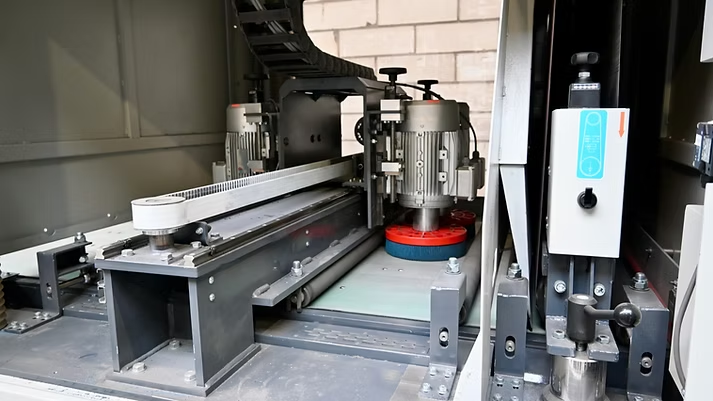
At the bottom, the sheet metal is held in place by a vacuum, while at the top, four rollers provide mechanical pressure across the entire width of the belt. This eliminates vibration. The sheet metal passes successively over a rough, vertically mounted sanding belt and two pairs of finer brushes. The latter move back and forth horizontally, rotating in pairs in opposite directions for a smooth finish.
PARAMETERS
The most important parameters of the deburring machine are the speed of the feed belt and the grit size of the sandpaper and brushes. "This allows us to achieve the desired finish. The thickness of the sheet material to be sanded also has to be set in advance. In any case, the operation is very simple. A short training session upon delivery was all it took to get started," Torfs explains.

EVALUATION
The operation is carried out by the same employee who previously cleaned the machine. He was therefore actively involved in the purchasing process. After a comparative test, the manufacturer ultimately chose the VG machine because of its robustness and favorable price-performance ratio compared to the other options on the shortlist.
"The fact that this is a Belgian manufacturer also played a significant role in our decision. This creates confidence in the delivery and after-sales service. After all, if a replacement part is needed, we want to be helped quickly," says the co-manager.
EXTRA ASSET
The concrete advantages of the TS-1060 are therefore primarily in the time savings—and therefore cost savings—and the consistent finish quality, compared to the previous situation. This multiple benefit undoubtedly justifies the purchase of the deburring machine. Moreover: "This investment wasn't so much prompted by customer demand, but the higher finish quality also strengthens our competitive position. This can therefore help us secure future projects," concludes Torfs.